
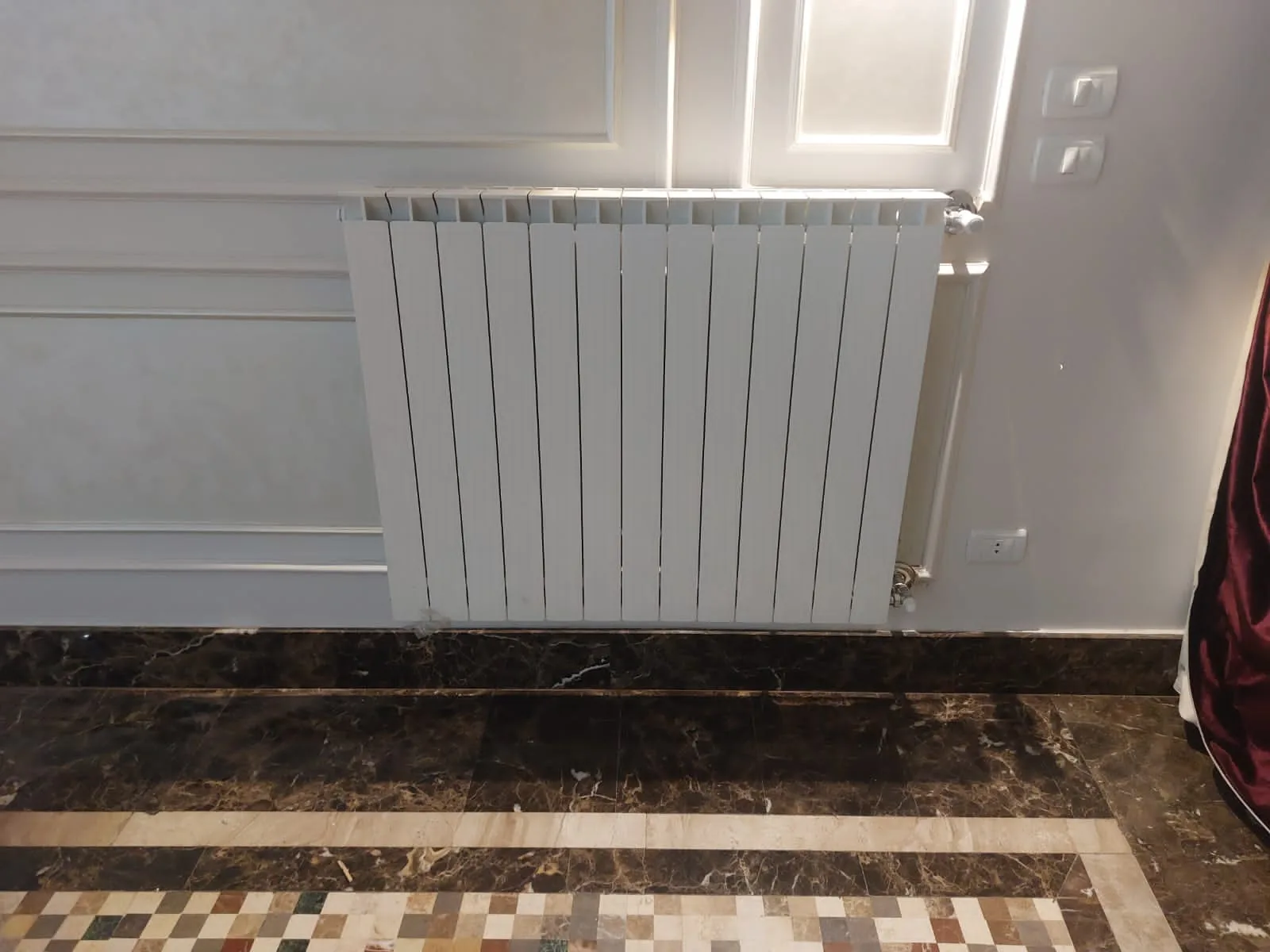
Radiators are the most widely installed heat emitter in Egypt, and in many properties they are the right answer — not a compromise. They respond quickly, cost less to install than underfloor heating, and can be fitted into a finished villa or apartment without lifting a single floor tile. This guide covers the types available, how they are sized, where they should be positioned, how they compare with underfloor heating, and what to look for when buying.
How radiators work
Hot water from a boiler or heat pump circulates through the radiator, which transfers that heat into the room. The name is slightly misleading: a panel radiator delivers a large share of its output by convection — warming air that rises and circulates — rather than pure radiation. Designer and stone-finish radiators shift that balance further toward radiant heat, which feels different and, to many people, more comfortable.
What matters practically is that output depends on the temperature difference between the water and the room. A radiator fed with 70 °C water in a 20 °C room emits far more heat than the same radiator fed with 45 °C water. This single fact drives most of the design decisions below.
Types of radiator
Panel radiators
The standard steel panel, available in single or double panel with varying convector fins. They offer the most output per pound spent and per metre of wall, which is why they dominate. Available in heights from roughly 30 cm to 90 cm and in a wide range of lengths, so they can usually be fitted to whatever wall space exists.
Aluminium sectional radiators
Built from cast sections that can be added or removed to tune output. Aluminium heats up and cools down faster than steel, which suits rooms used intermittently, and sectional construction gives flexibility that fixed panels do not.
Towel radiators
Designed for bathrooms, where they warm the room and dry towels simultaneously. Output per unit is modest, so in a cold bathroom a towel rail alone is often insufficient and needs supplementing.
Designer and stone-finish radiators
Where the radiator is visible in a finished interior, ultra-flat panels in natural stone or marble finishes deliver heat without looking like heating equipment. They emit a higher proportion of radiant heat and, being slim, intrude far less into the room.
Skirting-board heating
Not a radiator in the conventional sense, but the closest alternative: the emitter is concealed inside the skirting board around the room perimeter, freeing every wall completely while responding faster than underfloor heating. See our notes on skirting-board heating.
Sizing: output must match the room's heat loss
A radiator is sized to replace the heat a room loses. That loss depends on the room's area and ceiling height, its glazing area and type, how many of its walls face outside, its orientation, and the building's insulation. It does not depend on floor area alone, which is why the common practice of picking a radiator by room size produces so many cold corners and overheated hallways.
Two rooms of identical area can need very different outputs. A corner bedroom with two external walls and a large north-facing window loses far more heat than an internal room of the same size — sometimes double.
Manufacturer output figures are quoted at a stated temperature difference between water and room. If your system runs cooler than that reference condition, actual output will be lower than the catalogue number — which is exactly the trap people fall into when pairing radiators with a heat pump. Always check which condition a quoted output refers to.
You can calculate the requirement room by room for your own property with our free heating load calculator.
Positioning
Traditional practice puts radiators under windows, and the reasoning is sound: the window is usually the coldest surface and the biggest source of downdraught, and a radiator beneath it counteracts that cold air before it crosses the room. With modern well-insulated glazing this matters less than it once did, which gives more freedom in placement.
What consistently does matter:
- Do not box them in. Radiator covers and enclosures can cut output substantially. A radiator hidden behind a decorative cover is heating the cover.
- Leave clearance. Convection needs air to enter below and leave above. Furniture pressed against a radiator blocks that path.
- Long walls beat short ones. A long, low radiator distributes heat more evenly than a tall, narrow one of equal output.
- Consider furniture layout first. The radiator position you choose will constrain the room for years.
Radiators or underfloor heating?
This is the most common question and the honest answer is that it depends on the property and how it is used.
Radiators are better when floors are already finished and cannot be lifted; when rooms are used intermittently and need to warm quickly; when the budget favours lower installation cost; or when you are retrofitting into an occupied home.
Underfloor heating is better when you are building or renovating and the floors are open; when you want the most even comfort available; when you are pairing with a heat pump, since low water temperature is where heat pumps excel; and when you want wall space completely free.
Many villas sensibly use both — underfloor in the reception and living areas used consistently, radiators or towel rails in bathrooms and guest rooms used occasionally. See underfloor vs radiators and radiators vs UFH with a heat pump.
Radiators with a heat pump: what to know
Radiators can work with a heat pump, but not by simply swapping the boiler. Heat pumps are most efficient producing lower-temperature water, while conventional radiators were sized assuming hot water. Feed an existing radiator 45 °C water instead of 70 °C and its output falls sharply.
The solution is to size radiators for low-temperature operation from the start — which usually means physically larger radiators than a boiler system would need. That is a design decision, not a retrofit adjustment, and it is the step most often skipped when people convert a boiler system to a heat pump and then wonder why the house is cold. Read heat pump vs gas boiler for the wider comparison.
Controls and balancing
Thermostatic radiator valves let each room hold its own temperature, so bedrooms can be cooler than living areas without touching the boiler. This is straightforward, inexpensive, and one of the more effective efficiency measures available.
Balancing deserves particular attention because it is the cause of most complaints. Water takes the path of least resistance, so without balancing, radiators nearest the pump get more flow than distant ones — and the far end of the house never warms properly. Balancing adjusts each circuit so flow is distributed as designed. When a customer says "some rooms heat and others don't", the answer is almost always balancing or trapped air, not a faulty boiler.
Maintenance
Radiators need little attention, but the little they need matters:
- Bleeding. A radiator cold at the top and warm at the bottom has trapped air. Bleeding takes minutes.
- Cold at the bottom, warm at the top is the opposite problem — sludge accumulation, which may need a system flush.
- Inhibitor. System water should contain corrosion inhibitor, and its level should be checked periodically. This protects every metal component in the system.
- Valve operation. Thermostatic valve pins can seize if left in one position for months.
- Keep them clear. Dust between convector fins reduces output more than people expect.
Frequently asked questions
Do radiators work well in Egypt?
Yes. Egyptian winters are mild but real, and radiators' fast response suits properties that are not heated continuously — which describes most homes here.
What size radiator does a room need?
It depends on heat loss, not floor area — glazing, external walls, orientation and insulation all change the answer. Our load calculator works it out room by room.
Can radiators be added to a finished villa?
Yes. This is one of their main advantages over underfloor heating — pipework can usually be routed without lifting floors.
Why is one room always colder?
Usually system balancing or an undersized radiator for that room's actual heat loss, not a boiler fault.
Can I use radiators with a heat pump?
Yes, but they must be sized for lower water temperature, which generally means larger radiators. Reusing boiler-sized radiators with a heat pump is the classic mistake.
Are designer radiators worth it?
Where the radiator is visible in a finished interior, they deliver comparable heat while looking like part of the design. Output per metre is usually lower than a standard panel, so sizing has to account for that.
Talk to us
We supply and install radiators across Egypt from Giacomini, Sira, De Dietrich, Unical and Ariston, alongside CosyStone stone-finish radiators and ThermaSkirt skirting-board heating — and we size every room from a heat loss calculation rather than a rule of thumb. Explore our space heating solutions, read the central heating guide, run the free load calculator, or book a free site assessment.