
The wrong question and the right one
"What size water heater do I need?" is usually answered with a number of litres based on how many bedrooms a home has. That shortcut is why so many villas run out of hot water when two showers and the kitchen run together, and why so many hotels and gyms end up with far more storage than they ever use.
Hot water demand is not driven by bedrooms. It is driven by fixtures — how many outlets exist, what each one draws, and how likely they are to be used at the same time.
How proper sizing works
The recognised engineering approach sizes hot water per fixture. Each type of outlet — shower, bath, basin, kitchen sink, washing machine — has its own demand characteristics, and those are combined with a diversity assumption: in a real building, not every fixture runs at once. That combination gives you two numbers that matter:
- Peak demand — the worst realistic moment, which decides whether you ever run cold.
- Recovery rate — how fast the system reheats, which decides how long you stay cold if you do.
Storage volume alone tells you neither. A large tank with slow recovery and a small tank with fast recovery can serve the same building very differently.
Why residential and commercial are not the same calculation
A villa and a hotel have different usage patterns, not just different sizes. Residential demand is sharply peaked around mornings and evenings. Commercial demand — hotels, gyms, locker rooms, clinics — has different peaks, different simultaneity, and often a recirculation loop whose losses must be included. Applying a residential rule of thumb to a gym is how you end up with a system that fails at exactly the busiest hour.
Run the calculation on your own building
We built the per-fixture method into a calculator our engineers use, with separate residential and commercial paths so the right assumptions are applied to your case. You enter the actual fixtures, occupancy and usage pattern; it returns the heater capacity and storage you need.
Open the hot water calculator — free, and it gives you a number you can hold any supplier to.
Prefer we do it? Book a free assessment and we will size it on site.
Matching the number to equipment
Once you know the required capacity and storage, the next question is which type of system delivers it. We supply across the full range, so the recommendation follows the calculation rather than whatever happens to be in stock:
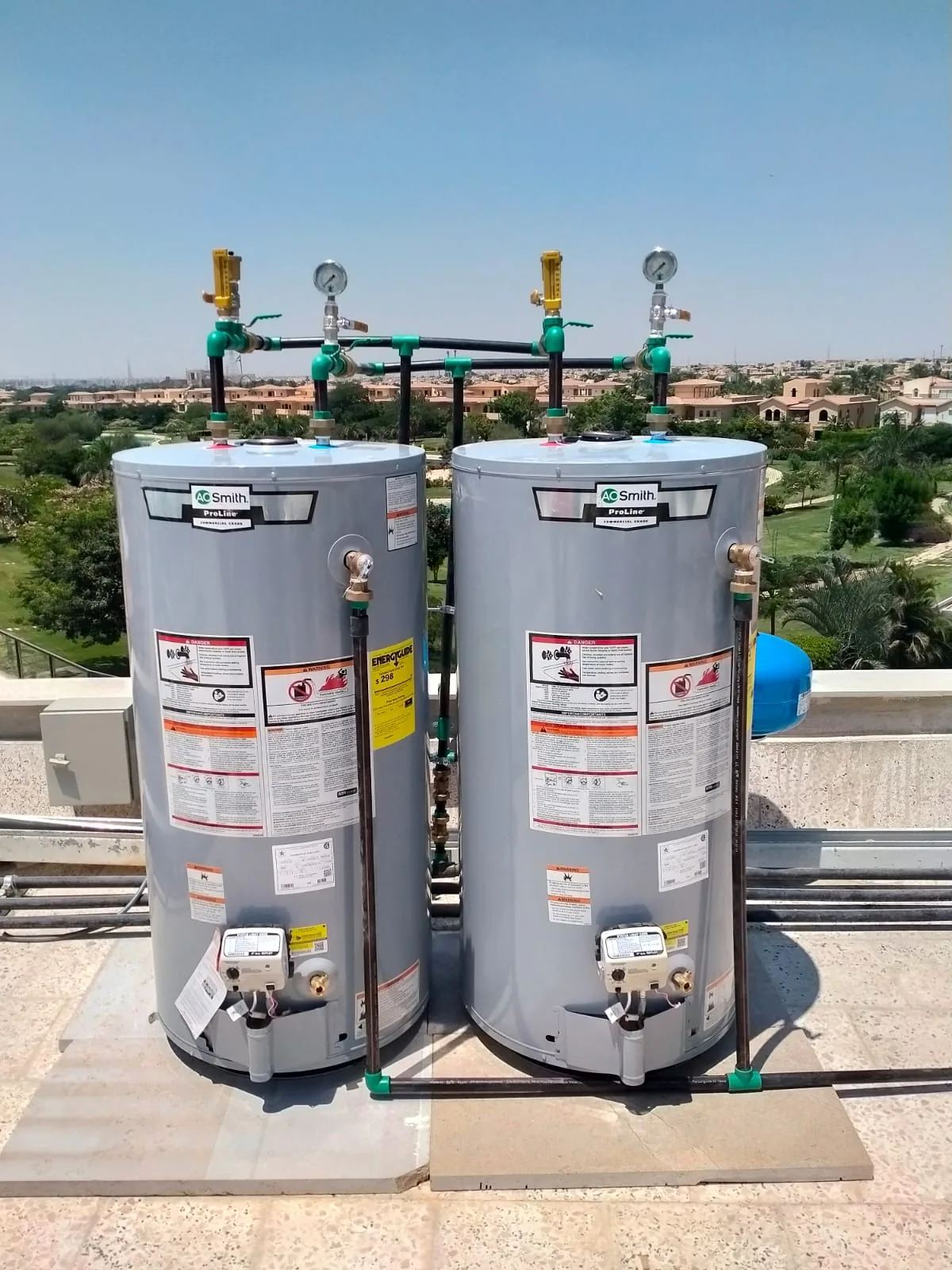
- Gas and electric storage heaters — Rheem, Bradford White, Richmond and A.O. Smith, the workhorses for most villas and apartments.
- Tankless (instantaneous) heaters — Heat Flow and Nardi, where space is tight and demand is intermittent.
- Solar water heating — Dimas, where roof space allows and running cost is the priority.
- Heat pump water heaters — Richmond and Heat Shift, the most efficient option for continuous demand; we are also the authorized exclusive dealer for GRAT heat pumps in Egypt.
The sizing comes first and the equipment second. A correct capacity with the wrong system type still disappoints — and the right brand at the wrong capacity disappoints faster.
What to ask your supplier
Ask how the size was calculated, whether peak demand and recovery rate were considered separately, and whether the figure came from a fixture count or from a bedroom count. The answer tells you immediately whether engineering was involved.
See also our guide to heat pump water heaters and our hot water solutions.