
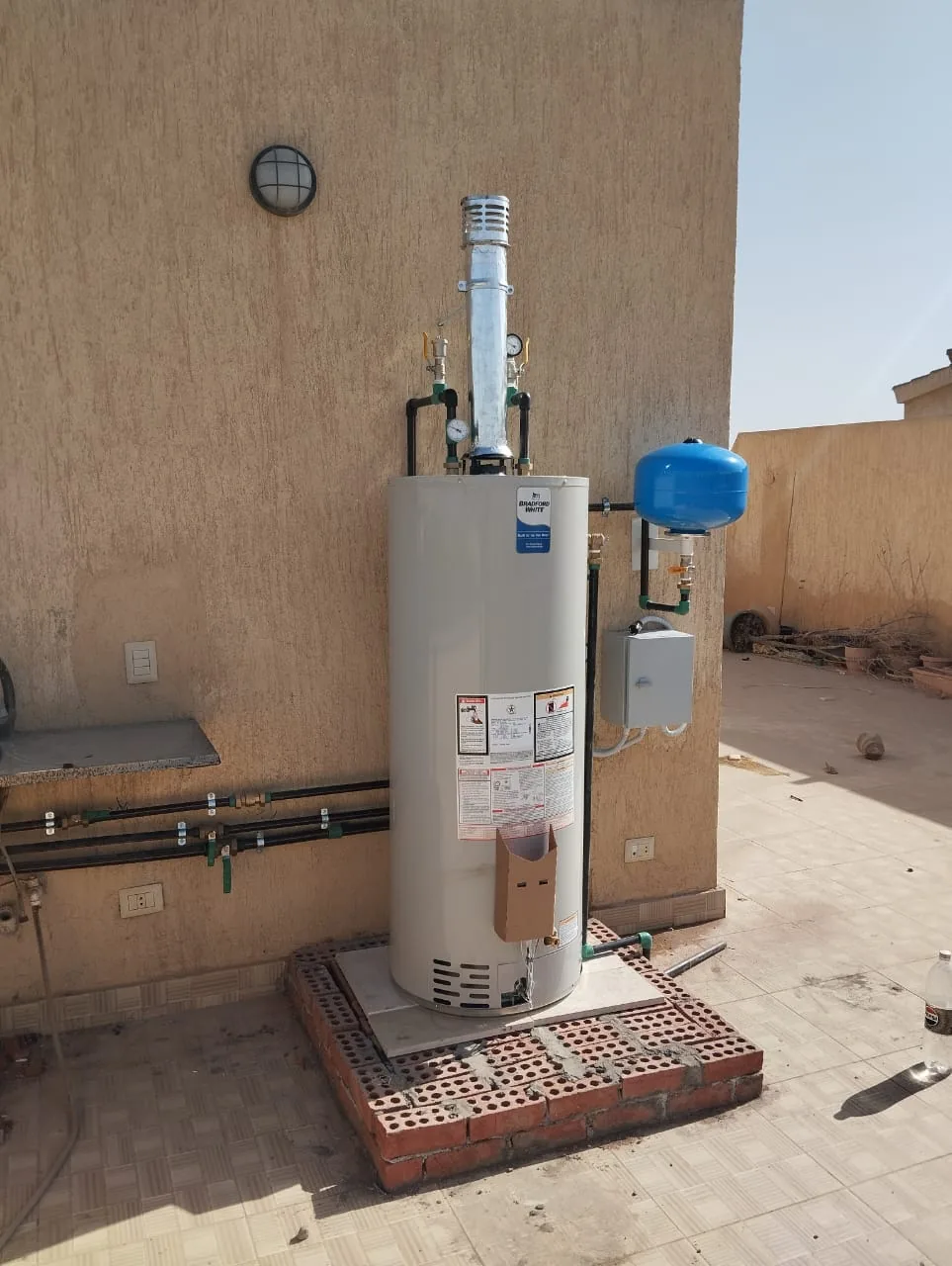
Gas remains the most common way to heat water in Egypt, and for good reason: gas is comparatively cheap, gas water heaters deliver a lot of heat quickly, and the technology is well understood by every plumber in the country. But "common" is not the same as "correctly specified", and the gap between a gas water heater that works well for fifteen years and one that disappoints from month one comes down to a handful of decisions that are usually made carelessly.
This guide covers the types available, how sizing actually works, the safety requirements that matter more than any other consideration, what these systems cost to run, and how to keep one working properly.
How a gas water heater works
A gas burner heats water, either as it flows through a heat exchanger or while it sits in an insulated tank. Combustion gases are carried outside through a flue. That is the whole principle, and its simplicity is the reason gas water heating has been the default for decades.
Everything that distinguishes a good installation from a bad one sits around that principle: whether the unit can deliver enough hot water at the moment you need it, whether the combustion products are safely removed, whether the heat exchanger will survive Egyptian water, and whether the gas supply can actually feed the appliance.
Instant (tankless) or storage?
Instant / tankless heaters
An instant heater fires only when a tap opens and heats water as it passes through. Nothing is stored, so nothing is kept hot while you sleep — there are no standing losses. They are compact, wall-mounted, and well suited to apartments where space is scarce.
Their limitation is flow rate. An instant heater can raise water temperature by a certain amount at a certain flow, and that is a hard ceiling. Open a second outlet and the temperature at both drops. This is why apartments with one bathroom are well served by instant heaters, and villas with three bathrooms running simultaneously often are not. Cold incoming water in winter also reduces the achievable flow, which is exactly when you notice it.
See our detailed notes on tankless gas water heaters for apartments.
Storage heaters
A storage heater keeps a volume of water hot and ready. This handles simultaneous demand far better — several outlets can draw at once because the stored volume absorbs the peak. The trade-offs are physical space, and standing losses: keeping water hot around the clock costs something even when nobody uses it, though modern insulation has reduced this considerably.
The practical rule is that storage suits properties with several bathrooms and clustered demand — a family villa where everyone showers within the same hour — while instant heaters suit smaller properties with sequential demand.
Sizing: peak demand and recovery rate
Sizing a gas water heater by the number of bedrooms is the standard shortcut and the standard cause of complaints. Hot water demand is driven by fixtures, not bedrooms: how many outlets exist, what each draws, and how likely they are to run at the same time.
Two numbers matter, and they are different from each other:
- Peak demand — the worst realistic simultaneous draw. This decides whether you ever run cold at all.
- Recovery rate — how fast the heater reheats after that peak. This decides how long you stay cold if you do.
A large tank with slow recovery and a smaller tank with fast recovery behave very differently in the same building, and a specification that quotes only litres has told you almost nothing. For a proper fixture-based calculation on your own property, use our free hot water sizing calculator, which has separate residential and commercial paths — because a villa and a gym have completely different simultaneity assumptions.
Natural gas or LPG?
Where mains natural gas is available it is almost always the better option: cheaper per unit of heat, no cylinders to manage, and no delivery to arrange. Much of urban Egypt is connected.
Where it is not — many North Coast and rural properties — LPG is the alternative. It works perfectly well, but three things change. Appliances must be configured for LPG, since burners and injectors differ; running cost per unit of heat is higher; and you take on cylinder logistics and storage. Critically, an appliance set up for natural gas will not operate correctly on LPG and vice versa. This conversion must be done properly, not improvised.
Safety: the part that is not negotiable
A gas water heater burns fuel inside your home. Everything else in this guide is about comfort and cost; this section is about not being harmed, and it deserves more attention than it usually gets.
- Flue and combustion product removal. Combustion produces carbon monoxide, which is colourless and odourless. It must be vented outside through a correctly specified, correctly installed flue. A blocked, disconnected or improvised flue is the single most dangerous fault in any gas installation.
- Ventilation. Room-sealed appliances draw combustion air from outside and are inherently safer. Open-flued appliances draw air from the room, and that room must have adequate permanent ventilation which must never be blocked up.
- Installation location. Bathrooms and confined unventilated spaces are the wrong place for open-flued appliances. Local regulations and manufacturer instructions govern this and should be followed exactly.
- Carbon monoxide alarm. Inexpensive, and the only thing that will warn you of a fault you cannot see or smell. Fit one.
- Competent installation and annual servicing. Gas work is not DIY work, and an annual check of combustion and flue integrity is what keeps a safe installation safe.
If a supplier is casual about flue routing or ventilation, that tells you everything you need to know about the rest of their work.
Egyptian water and why the heat exchanger matters
Water hardness varies considerably across Egypt and is significant in many areas. Hard water carries dissolved minerals that precipitate out when heated and deposit as scale on any hot surface — which, in a water heater, means precisely the surfaces that transfer heat.
Scale does two things. It insulates the heat exchanger, so the burner has to work harder and longer for the same output, and efficiency degrades gradually and invisibly. And it accelerates the conditions in which corrosion takes hold. This is why two identical heaters installed on the same day can be in completely different condition eight years later.
Three responses actually help: specify quality heat exchanger and tank materials rather than the cheapest available; where a storage tank uses a sacrificial anode, have it inspected and replaced on schedule rather than discovering it has dissolved when the tank fails; and in genuinely hard-water areas consider treatment upstream. See our guide to water heater tank materials for why this decides the lifespan of the unit.
Running cost and efficiency
Gas is comparatively inexpensive in Egypt, which is the main reason gas water heating dominates. But the running cost still varies substantially between installations, driven by:
- Appliance efficiency. Condensing units recover heat from flue gases that conventional units discard.
- Standing losses. Relevant to storage heaters, and much reduced by good insulation. Instant heaters have essentially none.
- Scale. As above — a scaled heat exchanger silently raises consumption.
- Distribution losses. Long uninsulated pipe runs waste both heat and water while you wait for it to arrive at the tap.
- Recirculation. Convenient in large villas, but a recirculation loop runs continuously unless it is controlled by a timer or thermostat, and an uncontrolled loop can consume more than the appliance itself.
The last two are the ones people never budget for. Insulating the primary hot water runs is inexpensive and pays back quickly.
Gas, electric or heat pump?
Gas gives you the lowest running cost of the conventional options where mains gas is available, high output, and fast recovery. It requires a gas supply and a flue, and it must be installed and serviced competently.
Direct electric is simplest — no gas, no flue, minimal installation constraints — and the most expensive to run, because every kilowatt of electricity produces exactly one kilowatt of heat.
Heat pump water heaters do not generate heat; they move it from the surrounding air into the water, returning several times the energy they consume. This makes them the most efficient option available, and the gap widens the more hot water you use. They cost more upfront, need space and air flow, and heat more slowly than a gas burner, which makes storage capacity part of the design rather than an afterthought.
The honest summary is that gas suits properties with a mains connection and high peak demand; heat pumps suit properties with steady high consumption where running cost over a decade matters more than initial outlay; and direct electric suits small or isolated applications. For the detailed comparison read heat pump vs gas water heater and our complete heat pump water heater guide.
Installation details that decide satisfaction
- Gas supply capacity. The pipework must actually deliver the flow the appliance needs. An undersized gas line starves the burner and produces symptoms that get misdiagnosed as a faulty heater.
- Water pressure and balance. Many instant heaters need a minimum flow to fire at all, and unbalanced hot and cold pressures make mixer taps behave erratically.
- Pipe routing and insulation. Shorter runs to the most-used outlets mean less waiting and less waste.
- Isolation valves and access. A unit installed where it cannot be serviced will not be serviced.
- Commissioning. Gas pressure, combustion, flue integrity and temperature settings should all be verified and recorded at handover, not assumed.
Common faults and what they mean
- Water not hot enough at high flow. Usually an instant heater at its flow limit rather than a fault — the unit is undersized for the demand.
- Temperature swings when another tap opens. Classic instant-heater behaviour under simultaneous demand.
- Takes longer than it used to. Typically scale on the heat exchanger.
- Burner will not ignite. Gas supply, ignition components, or insufficient flow to trigger firing.
- Yellow or sooty flame. Stop using the appliance and call a competent engineer immediately. This indicates incomplete combustion and a carbon monoxide risk.
- Rusty water or weeping from a storage unit. Corrosion is advanced; the tank is usually near the end of its life.
Maintenance
An annual service should verify gas pressure and combustion, inspect the flue and its seals, descale or clean the heat exchanger where required, check the anode in storage units, test safety devices including the pressure relief valve, and confirm temperature settings. Descaling on schedule in hard-water areas is the single most cost-effective maintenance action available, and the one most often skipped until performance has already degraded.
Frequently asked questions
Instant or storage for an Egyptian villa?
Storage usually suits villas with several bathrooms and clustered demand; instant units suit apartments and sequential use. The deciding factor is simultaneous demand, not floor area.
What size do I need?
It depends on fixture count and simultaneity, not bedrooms. Our hot water calculator works it out on a fixture basis.
Is a gas water heater safe in a bathroom?
Open-flued appliances should not be installed in bathrooms or unventilated confined spaces. Room-sealed appliances have different requirements. Follow local regulations and manufacturer instructions exactly, and fit a carbon monoxide alarm.
Why has my heater got slower over the years?
Almost always scale on the heat exchanger reducing heat transfer. Descaling usually restores much of the lost performance.
Can I run a natural gas appliance on LPG?
Not without proper conversion by a competent engineer. Burners and injectors differ, and running an appliance on the wrong gas is unsafe.
Gas or heat pump?
Gas for lower upfront cost, fast recovery and high peak demand with a mains connection. Heat pump for the lowest running cost over time with steady consumption.
Talk to us
We supply and install gas water heaters across Egypt from Rheem, Bradford White, Richmond and A.O. Smith, alongside tankless units from Heat Flow and Nardi — and we size every installation on fixtures rather than guesswork. Explore our hot water solutions, run the free sizing calculator, or book a free site assessment.