
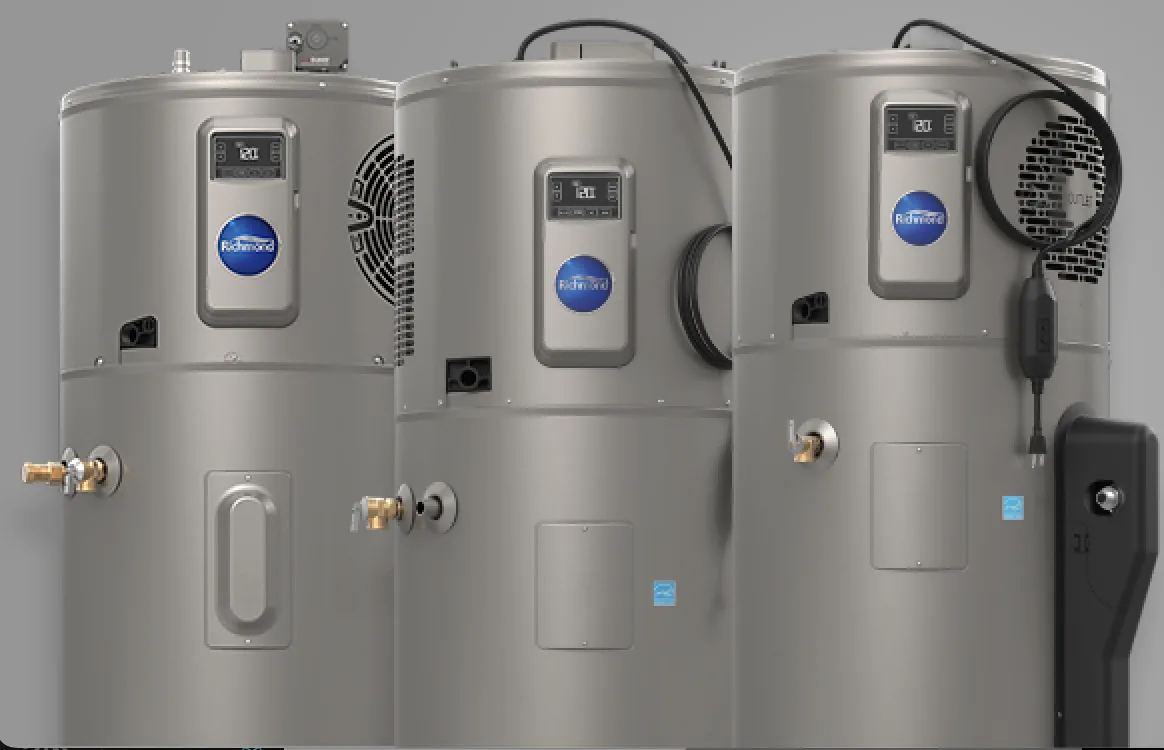
The electric storage heater is the default in most Egyptian homes — affordable, familiar, and on the shelf of every appliance shop. But "cheap to buy" and "cheap to own" are two different things. If you are replacing an old heater or fitting out a new home, it is worth understanding exactly what you gain by moving from a standard electric water heater (EWH) to a heat pump water heater (HPWH).
They both run on electricity — but not in the same way
This is the key point, and it surprises most people: a heat pump water heater is also an electric appliance. It plugs into the same single-phase 220–240V supply, needs no gas line, and installs in similar locations. The difference is entirely in how efficiently it turns that electricity into hot water.
- A standard electric heater uses a resistance element — electricity becomes heat at a one-to-one ratio. Its efficiency cannot exceed 100% (a COP of 1.0).
- A heat pump uses that same electricity only to move heat out of the surrounding air into the water, delivering 3 to 4.5 times more heat than the electricity it draws (a COP of 3.7–4.5).
So the heat pump is not a different fuel — it is the same fuel used three to four times more efficiently.
What that means for your bill
Because heating water is mostly about energy, not equipment, the running-cost gap is large and permanent:
- A Richmond ODIN heat pump produces about 2.68 kWh of hot water for every 0.667 kWh of electricity — roughly 4.2× the output of a resistance heater drawing the same power.
- Across the Heatec range, a HPWH typically uses up to 75% less electricity than an electric heater for the same volume of hot water.
For a household that heats water every day, that saving repeats 365 days a year for the 10–15 year life of the unit. The heat pump costs more up front, but the daily electricity it doesn't use is what pays back the difference.
Side-by-side for an Egyptian home
| Standard Electric Heater (EWH) | Heat Pump Water Heater (HPWH) | |
|---|---|---|
| Energy source | Electricity (resistance) | Electricity (heat pump) |
| Efficiency (COP) | ~1.0 | ~3.7 – 4.5 |
| Electricity for same hot water | 100% (baseline) | up to 75% less |
| Gas line required | No | No |
| Installation | Simple | Comparable; needs ventilated space for airflow |
| Hot water reserve | Tank | Larger insulated tank (85–300 L) |
| Backup for peak demand | Element only | Heat pump + built-in electric backup |
| Smart/app control | Rarely | Yes (Wi-Fi on all three brands) |
| Up-front cost | Lower | Higher |
| Lifetime running cost | Higher | Much lower |
The practical advantages, beyond the bill
An easy swap. Because a HPWH is an electric appliance, moving from an electric heater is straightforward — no new gas connection, no flue, no combustion. For most homes it is the simplest possible upgrade.
A free dehumidifier. As the heat pump pulls heat out of the air, it also cools and dries that air slightly. In a laundry room, store room or coastal home on the North Coast, that gentle dehumidification is a welcome bonus — the Heat Shift Hot Spot model is specifically designed to use this.
The same hot water you are used to — or more. With tanks up to 300 litres and heat-pump temperatures up to 75°C, you are not trading comfort for efficiency. The built-in electric backup is still there for the rare heavy-demand moment, so the experience at the tap is identical.
Quieter and smarter. Units run as quietly as 40 dB(A) — about the level of a library — and connect to a phone app so you can schedule heating, switch on a fast "boost," or set a holiday mode while you are away.
When does a plain electric heater still make sense?
Honesty matters: if your hot-water use is very small (a single occasional tap), or your budget cannot stretch to the higher purchase price right now, a basic electric heater is still a valid, low-cost choice. The heat pump's advantage grows with how much hot water you actually use — so the more people in the home, the faster it pays back.
For a family villa or a full apartment, the maths almost always favours the heat pump. Heatec can model the expected saving against your current heater before you decide.